
The purchasing group model has existed for generations, helping independent businesses compete with larger rivals through collective buying power, shared expertise and stronger supplier relationships.
Yet, as markets evolve, technology advances and member expectations change, a new question is emerging for co-operative leaders: what will make a purchasing group relevant 10 years from now?
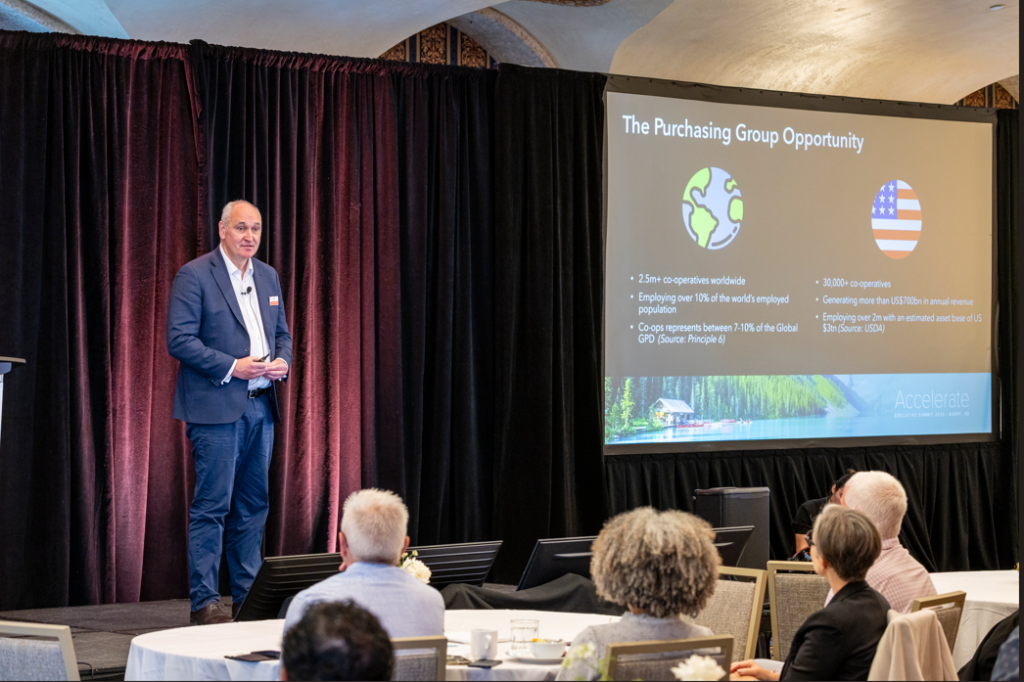
This was one of the key themes explored during a panel session chaired by Moorgate Management’s Founder Chris Maityard at the LBMX Accelerate conference in Sonoma, where industry leading panelists from North America, Ireland and academia discussed the future of purchasing groups and co-operatives.
The discussion revealed a clear message: the groups that thrive over the next decade will be those that are member centric, and move beyond purchasing to become indispensable business partners to their members.
Historically, purchasing groups and co-ops have been measured by their ability to negotiate favourable supplier terms, rebates and purchasing agreements. While those functions remain important, they are increasingly being viewed as the entry ticket rather than the primary source of value of belonging to a co-operative.
Instead, today’s members face a much wider range of business challenges. Labour shortages continue to affect many sectors, and succession planning has become a growing concern as current business owners approach retirement, creating the potential for the member to be purchased by someone outside the buying group and subsequently leave, with the loss of purchasing power. Meanwhile, the global digital transformation is creating both opportunities and risks. AI is beginning to reshape how businesses operate, while customers increasingly expect a seamless online experience alongside the traditional high service levels that co-operatives are known for.
The most successful purchasing groups are those who are responding by broadening their support in these areas.
Many are investing in leadership development programmes such as Executive Education, onboarding initiatives and training resources designed to help members attract, retain and develop the right talent. Others are helping members to improve operational performance through ERP systems, ecommerce platforms and digital business tools.
Some are supporting members’ succession planning by helping to identify future leaders and creating pathways for the next generation of business owners and, where members are actually looking to retire and exit, working with other members within the group to create a pathway to retain the business by matching them with members who are looking to acquire.
Technology will, inevitably, play a central role in this evolution.
For many independent businesses, gaining access to advanced technology can be difficult due to cost, expertise or resource constraints. Co-ops and purchasing groups have a unique opportunity to bridge that gap by providing their members with access to technology, data, AI tools and specialist knowledge that individual members may struggle to obtain on their own.
The panel also highlighted another area where purchasing groups can create value: acting as a connector.
Whether bringing together suppliers, universities, technology providers, investors or industry experts, these groups have the ability to create relationships and opportunities that would otherwise be unavailable to their members. This role as a facilitator of innovation may become one of the defining characteristics of successful co-ops in the years ahead.
Supplier relationships remain equally important.
The strongest purchasing groups recognise that their suppliers are not simply rebate providers. They are strategic partners who can contribute training, education, innovation and market expertise, while creating a stronger collaboration between suppliers and members that can benefit the entire ecosystem.
Perhaps the most interesting conclusion from the panel session was the overwhelming belief that purchasing groups will remain highly relevant well into the future. Not because they negotiate prices or administer rebates, but because independent businesses will continue to need support, expertise, education and technology in order to thrive.
The co-ops who understand this shift and adapt their value proposition accordingly will continue to grow, while those who remain focused solely on transactions may find themselves struggling to maintain relevance in a changing world.